A brief history of this historic 1907 Edwardian era Steamship, and her century-long journey through time…

118 Years Later, Keewatin’s Legacy Echoes Across the Great Lakes…
Legend has it that the story of the acquisition of the S.S. Keewatin and her sister ship S.S. Assiniboia really began with Russia’s Tsarist autocracy and the revolution of 1905. The Tsar commissioned two ships from Fairfield Shipbuilding and Engineering in Glasgow Scotland, often known simply as ‘Fairfields’, a company responsible for the creation of other impressive vessels including the R.M.S. Empress of Ireland, the R.M.S. Empress of Britain, the S.S. Athenia and many other cruisers, battleships, and passenger ships. In 1905 mass political and social unrest spread throughout the Russian Empire, and led to a number of constitutional reforms. As a result, the Tsar could no longer afford to take the ships he had commissioned. So Fairfields was in need of a new buyer.
In an attempt to sell the ships Fairfields contacted the Canadian Pacific Railway, who had already purchased the Alberta, the Athabasca, and the Algoma from another Scottish ship building company in 1883. These three ships also have a unique history. In 1883, they travelled across the Atlantic from Scotland to Canada without issue. Upon arrival were cut in half at the Cantin shipyards to ensure they could fit through the St. Lawrence and Welland Canals and were reassembled when they reached Buffalo.
Mr. R J Duff of the CPR was contacted by Fairfields about the Russian-ordered ships. While he knew they were too long for transport he also knew that they could potentially be cut in half just as the previous ships were. Canadian Pacific Rail decided to purchase the ships. Upon their arrival SS Keewatin and SS Assiniboia were cut in half at the Davie Shipyard in Lauzon Quebec, towed up the St Lawrence River and through the Welland Canal to Buffalo NY where they were re-assembled at the Buffalo Dry Dock Company.

On arrival in 1907 at Montreal, Keewatin is registered to Canadian Pacific Railway.
The following information provided by Naval Marine Archive ‘The Canadian Collection—>

The Steam Ship S.S. Keewatin (1907)
General
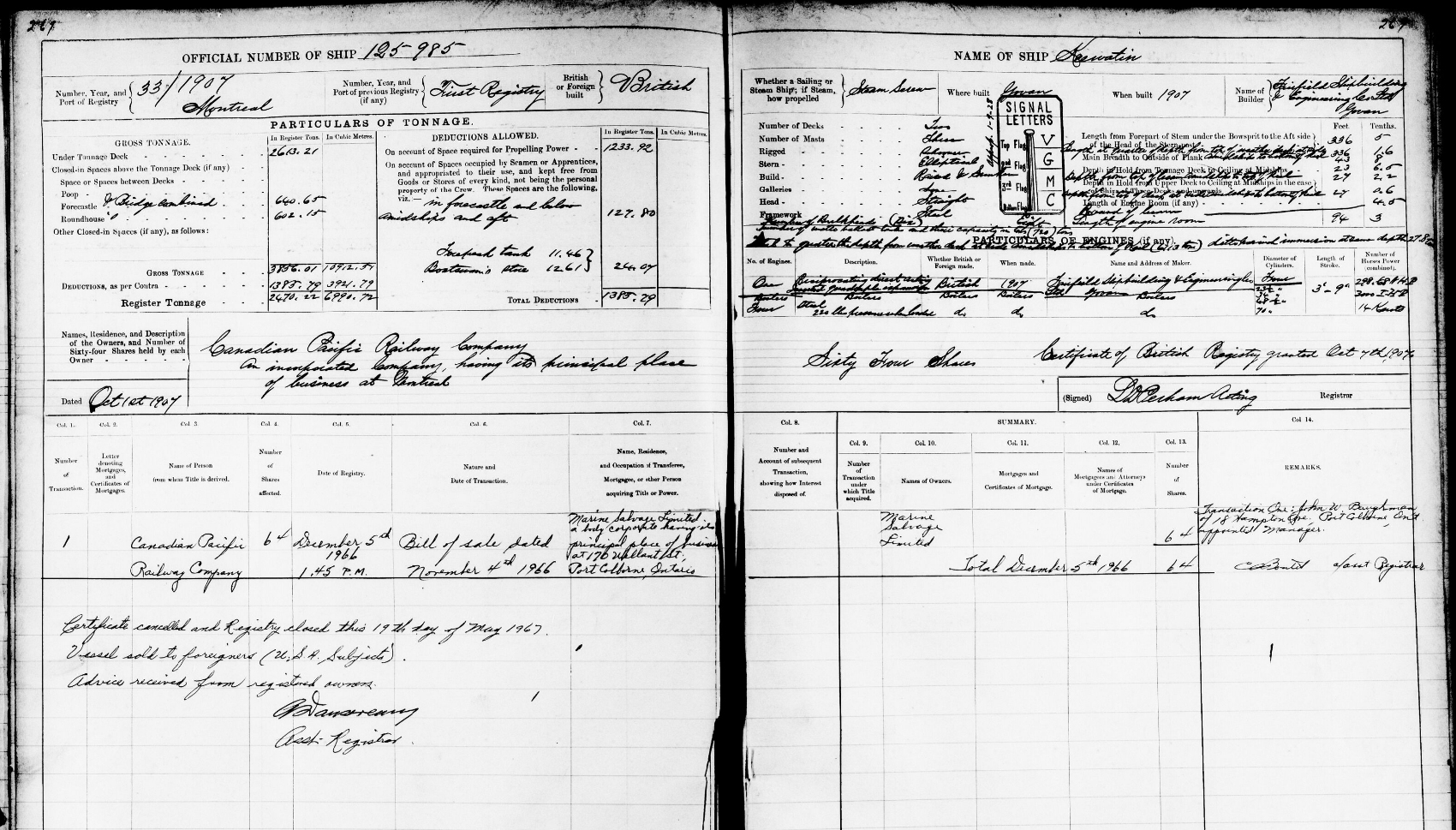
Montreal Register (1907)

Click for an enlarged image –>

NOTATIONS:
- Engine 4 cylinder, reciprocating, direct acting, quadruple expansion, 23½, 34, 48½ & 70 in. bore, 3′ 9″ stroke, 298.68 nhp, 3000 IHP, for service speed 14 knots. 4 steel Scotch boilers at 220 psi. all by Fairfield Shipbuilding & Engineering Co., Govan, Scotland, 1907.
- Signal letters: VGMC
- Certificate cancelled and Registry closed this 19th Day of May 1967. Vessel sold to foreigners (USA subjects). Advice received from registered owners.
Montreal register, 1907-1967 Click for enlargement.
Notes
- The Keewatin made her maiden voyage from Glasgow (the John Brown Yard?) to Montreal (1907-09-14 to 1907-09-23) in cargo (steel pipes), no passengers. Between October 5 and 15, she was cut in half by the Davie Shipyard (Lauzon/Lévis QC) (planned removal of rivets) for towing through the St Lawrence, Lake Ontario and Welland Canal (locks insufficient for her length) to the Buffalo Drydocks, for replacement of the rivets manufactured by Fairfield Shipbuilding and carried as cargo. This operation was completed by 19 December 1907.
- Fairfield Shipbuilding & Engineering Co. of Govan, Scotland, were by far the biggest shipbuilders contracted by the Canadian Pacific Railway Company, building twenty-one ships, for a total of 243,237 gross registered tons.
- The Keewatin‘s original hull colour was black. She was repainted white in 1919 and has remained so ever since.
- The Keewatin, more often in her early days, has been described as a “schooner.” This is a somewhat romantic misinterpretation of the fact that she was built with three masts. These mast were not designed to carry sail, were not rigged to do so, and never did carry sail – they were mostly for aesthetic reasons, but could probably have been rapidly rigged, in harbour, to assist with cargo handling; other uses would have included flying signals, and eventually radio antennae.
- At some time around 1950, the Keewatin had her original three wooden masts replaced with two steel masts. Zimmmerman “Ninety five years young”, suggests that she lost her mizzen, but that in 1955, her mainmast was moved aft of her funnel to the original position of the mizzen.
- The Keewatin was in passenger service until 1965, when rising operational costs and more stringent safety regulations put an end to CPR passenger services on the Great Lakes. The Keewatin continued carrying cargo until 1966.Newspaper and other transcriptions
- The Fairfield Shipbuilding & Engineering Co., Govan, launched on Saturday the screw steamer Keewatin for the Canadian Pacific Railway Company’s service on the Great Lakes of North America…. the naming ceremony being performed by Miss Piers, daughter of Mr. Piers, manager of the Canadian Pacific Railway Company’s steamship lines. Glasgow Herald, 8 July 1907.
- On October 5th [1907] the Keewatin arrived at Levis Dry Dock, Quebec, to be cut in two … a procedure not unfamiliar at the time. Telescope, Vol XLIV, number 3, May/June 1996, Howard J. Peterson.
- Keewatin, built by Fairfields, Glasgow in 1907 for Canadian Pacific’s Great Lakes route, is the centrepiece of a major property and community regeneration scheme beside Port McNicoll Ontario. (Promotional flyer, Skyline International) … a US-Canada co-operative effort saw her return to Port McNicoll in 2012 as the lynchpin in a major regeneration project for the town. She was back in that Great Lakes port 45 years after she had left it and 100 years since she began work there. Sea Breezes, December 2014, 086/828, p.16.
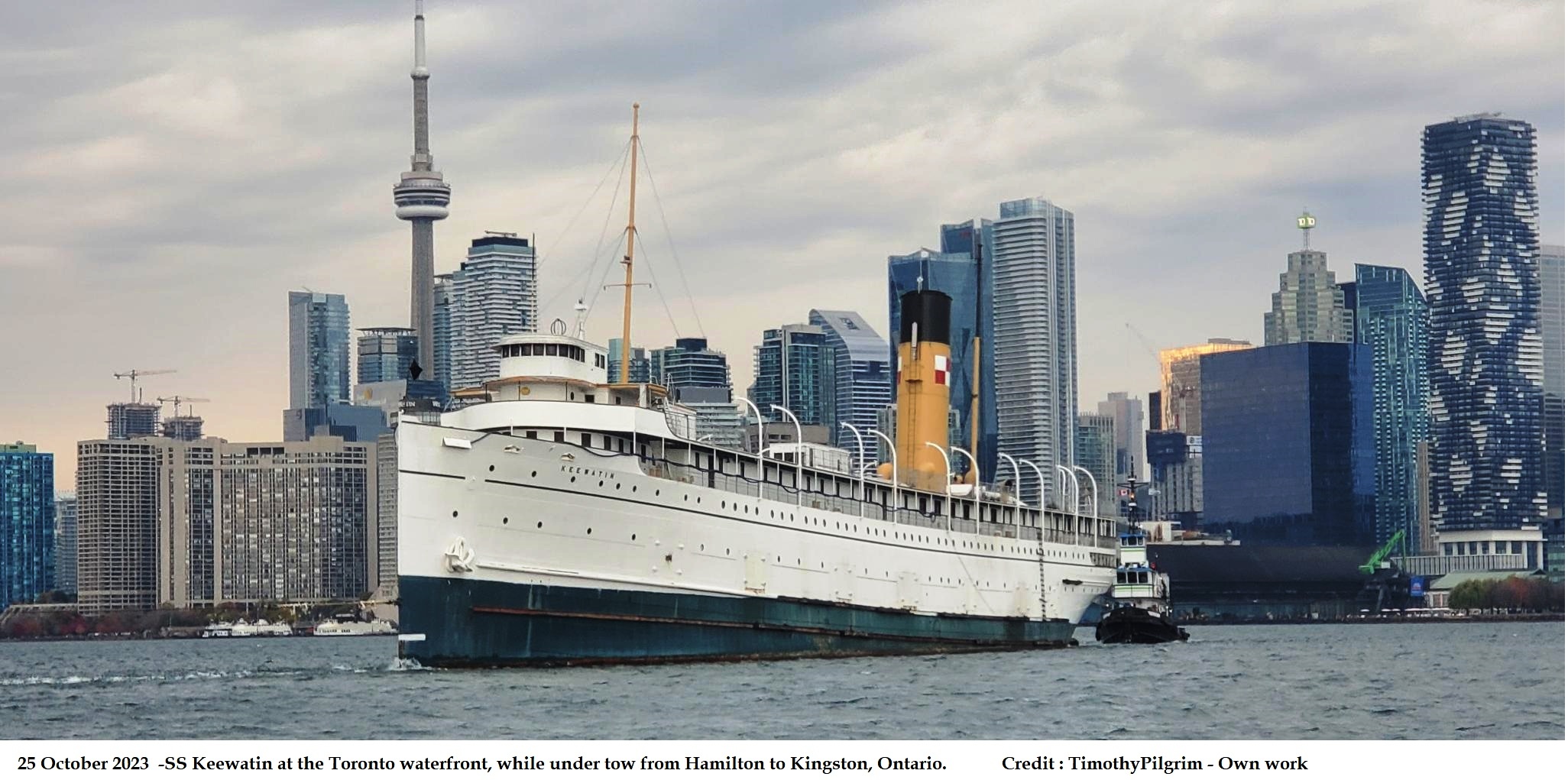
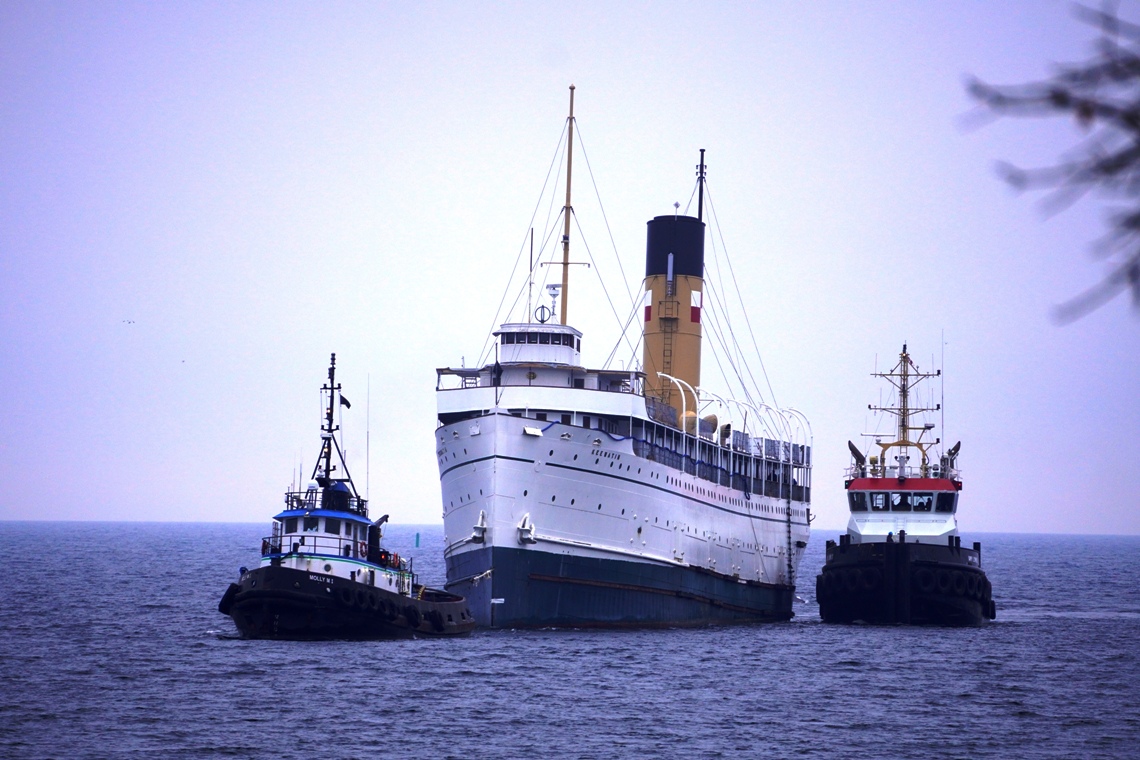
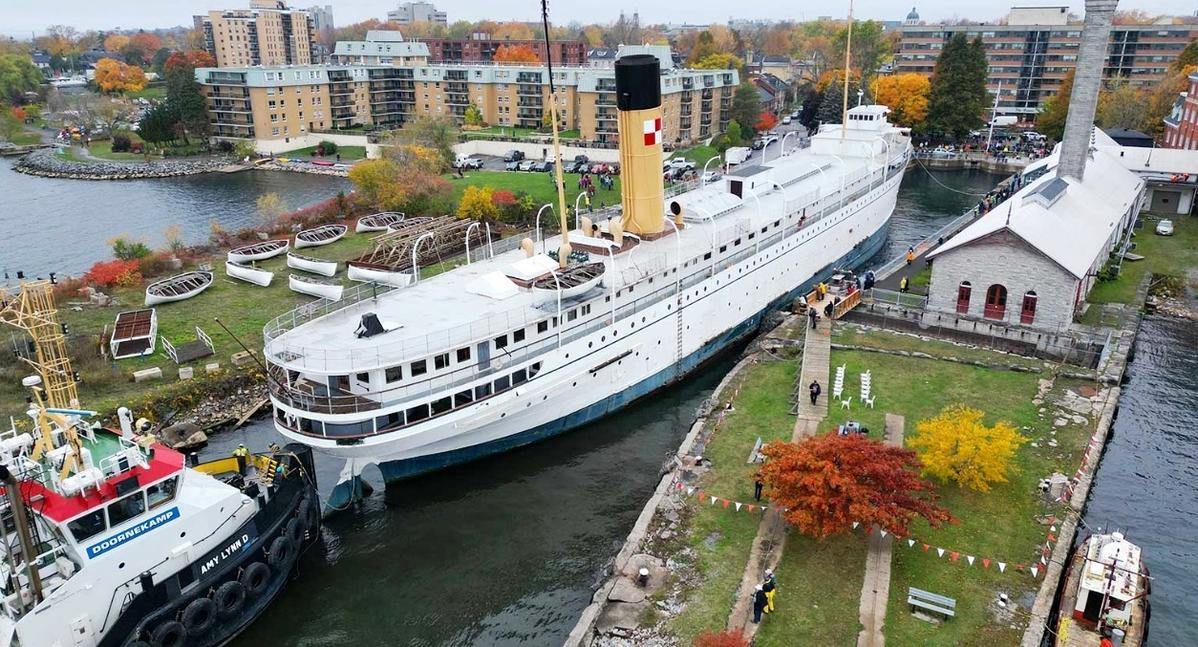
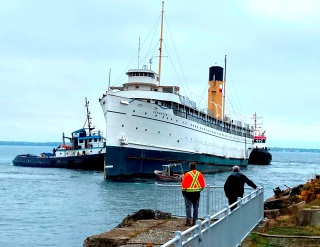
- SS Keewatin towed in to Hamilton Harbour … A historic Great Lakes passenger ship that was once the link between Canadian Pacific Rail lines was towed through the Burlington Canal into Hamilton Harbour Saturday, delighting onlookers. … to Heddle Marine in the harbour where it will undergo a $2-million retrofit. … Following the retrofit, the ship will be moved to the Marine Museum of the Great Lakes at Kingston. The attraction is set reopen in 2024. The Hamilton Spectator, April 30, 2023.
- References and source notes
- (2-4) Various register entries
- (5-10) NMA archival records
- (11- ) Newspaper and other source transcriptions

For the first 4 years Keewatin and her sister ship SS Assiniboia operated between Owen Sound and Port Arthur. In 1912 CP Rail moved operation to a new deep water eastern terminal at Port McNicoll, where Keewatin operated from for most of the remainder of her career, running opposing routes with her sister ship carrying both passengers and freight between there and Port Arthur (a 2 1/2 day trip each way).

Well piloted and cared for, both Keewatin and her sister ship Assiniboia serve Canadian Pacific well for six decades… transporting passengers and freight across Georgian Bay and Lake Superior.
By 1965, increasing government fire safety regulations, and opening of the Trans Canada Highway across the north of Lake Superior results in the wthdrawel from service of both Keewatin and Assiniboia.
SS Keewatin is withdrawn from passenger service on 29 November 1965. She then continues freight-only service until the fall of 1966, when her steam engines are shut down for the final time.

Fortunately in 1967 Keewatin is saved from being scrapped, by entrepeneur R.J. Peterson, who has the ship moved to Douglas MI, where he maintains her as an attraction for 45 years at the Keewatin Maritime Museuem.
At some point while in Michigan, R.J. Peterson adds an extension onto the stairwell enclosure near where Keewatin’s original radio shack was located… where he stages the ship’s early Marconi radio equipment, on loan from the Toronto Marine Museum archives.

These artifacts would ultimately be returned to the Toronto Marine Museum archives, when Keewatin was repatriated to Port McNicoll.
In 2011, R.J Peterson opts to return Keewatin to Canada, under an agreement with Skyline International Developments. This move requires dredging a mile long channel from the shores of the Kalamazoo River at a cost of $1 Million to allow Keewatin to be towed out from its’ berth. Keewatin departs Saugatuck MI on June 4th 2012.
On June 23, 2012 Keewatin returns to the same dock in Port McNicoll that she had departed from exactly 46 years earlier.

Keewatin remains



More Keewatin pictures here —>
 Canadian Amateur Radio Heritage