

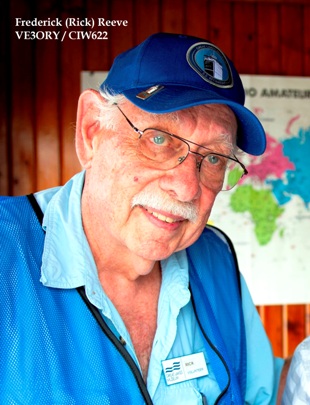
Born in St Catharines Ontario, I got my first Amateur Radio operator’s license in 1965. Back in those times, the Amateur Radio licensing program was much different from today. Morse Code proficiency at 10 WPM (words per minute) was required, along with relatively extensive training in basic electronics theory and regulations, as pertained to Amateur Radio. I remember taking a 3-month training course through the local ‘Ham Radio’ club in St. Catharines, before taking my licensing examination, which at that time was administered by the Federal government’s Department of Transport. Things have certainly changed since then!
After receiving my Amateur Radio ‘Operating Certificate’ I was issued my original call sign VE3GGZ. I held that call sign for about 5 years, operating initially from St. Catharines ON, and then for a few years from Burlington, Ontario.
In those days the basic Amateur Radio license required that my initial operating was done using Morse Code (CW) only. I look back on that now as being those times when I first realized the magic of radio communications. My father, who before WW II spent some time working as a telegrapher, and my late uncle Fred Reeve, VE3ALL were both influential in nurturing my interest in this wonderful hobby.
During my later teens and early 20’s, Amateur Radio took somewhat of a back seat as I started into university, and then joined Ontario Hydro as an ‘Operator’ in the early years of its’ development of nuclear power generation. Suddenly, a steady pay-cheque allowed me to pursue the other thing that seemed magic to me, and I immediately started into flying lessons.
That led to a 15-year period of obsession with aviation, eventually leading to my resigning from Ontario Hydro to fly commercially in the ‘General Aviation’ industry and ultimately obtaining an ‘Airline Transport License’. During that period, my only ‘radio’ operating was in communicating with Air Traffic Control. And, I was able to maintain some of my Morse Code proficiency by listening to the unique Morse identifiers associated with each of the ground-based airways navigation beacons.
During the 8 years that I was flying commercially I got married, started a family, and in 1985, decided to rejoin Ontario Hydro Nuclear, where I completed a 32 year career in the nuclear industry before retiring in 2011.
As soon as I rejoined Ontario Hydro in 1985, I again became very active in Amateur Radio, and have remained so ever since. Because my original VE3GGZ call sign had lapsed, I had to a apply for a new station call sign and obtained my current call VE3ORY, which I have used ever since. I did eventually reaquire my original call, and now hold both. Recently, I also acquired a 2-letter call-sign VA3DO which I use for the Winter and Summer Field Day events. I’m also an active member of the Canadian Forces Affiliate Radio Service (CFARS) and hold the Canadian Forces assigned call CIW622. Most all of my amateur operating is done using my VE3ORY call.
In 1987 I received an ‘Advanced Amateur License’, which back then also required another code proficiency test at 15 WPM. Current ‘Amateur Radio’ licensing no longer requires a demonstrated proficiency in Morse Code (CW), although a code proficiency qualification is still available, and CW is still widely used (amongst many other modes, these days). Many ‘Ham’ operators, including myself, still enjoy using that first means of radio communication. With a little practice CW becomes a language of its’ own. Even though Morse Code has long since been superseded by much more technically advanced methods of radio communication (with which ‘Ham’ operators are also involved), many still enjoy sending and receiving contacts with each other using CW.
Like other technologies radio communication is evolving at exponential rate. Consequently, in my opinion, the magic of radio communication never wanes. This website celebrates some of that constant evolution.
 Canadian Amateur Radio Heritage